×
Back to menu
HomeBlogBlogReal Estate Crowdfunding Checklist: Equity vs. Debt

Real Estate Crowdfunding Checklist: Equity vs. Debt

Real Estate Crowdfunding Checklist: Equity vs. Debt

Real Estate Crowdfunding Checklist: Equity vs. Debt

Nathan Brown · 6 min

Real Estate Crowdfunding Checklist: Equity vs. Debt

A More Disciplined Way to Compare Opportunities

Real estate crowdfunding can provide access to property investments without direct ownership or day-to-day landlord responsibilities. Yet platforms, fees, legal structures, liquidity terms, and project risks vary widely.

A disciplined review begins before projected returns enter the conversation. Define the role of the investment, examine the platform and sponsor, compare equity with debt, and document every assumption before committing capital.

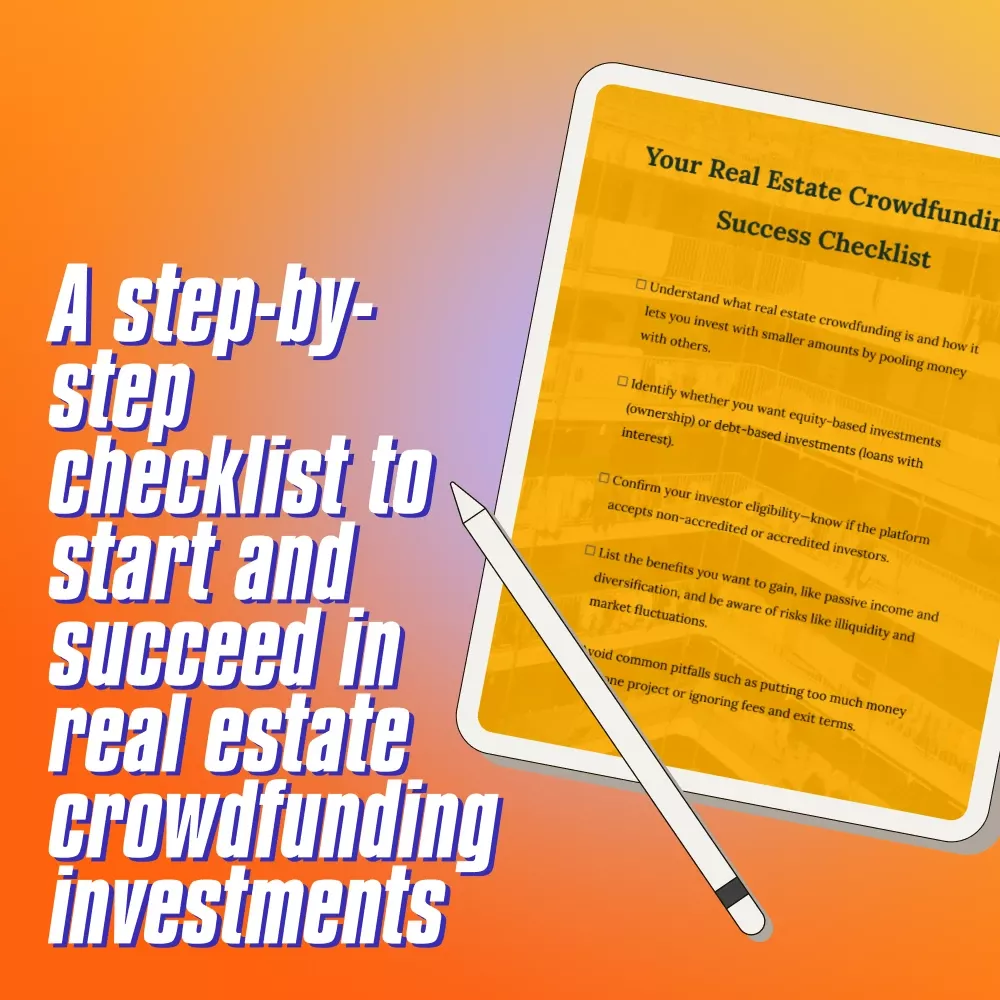
Your Real Estate Crowdfunding Success Checklist in an appropriate real-world setting

Evaluate the Crowdfunding Platform

Review the platform operator’s history, management experience, selection process, and conflicts of interest. Determine which legal entity issues the investment, how property interests and investor funds are held, and what could happen if the platform stops operating.

Examine account, servicing, asset-management, transaction, and performance fees. Identify whether each expense is charged to investors, the project, or both. Reliable platforms should provide accessible offering documents, financial reports, tax-document timelines, distribution notices, and regular project updates.

Read written redemption and transfer rules without assuming a secondary-market buyer will be available. Check regulatory records and independent sources such as FINRA’s crowdfunding guidance rather than relying exclusively on testimonials or advertised returns.

Featured in this guide

Your Real Estate Crowdfunding Success Checklist | Digital Download for Real Estate Crowdfunding Platforms, Equity & Debt Investing Guide

View product

Compare Equity and Debt Investments

Equity investors generally acquire an ownership interest connected to a property or project. Returns may come from operating distributions and appreciation, but they depend on rental income, expenses, financing, and the eventual sale price.

Debt investors fund a loan or related debt instrument. Potential returns commonly come from interest and principal repayment. Borrower default can still cause delayed payments, restructuring, foreclosure, and losses.

Feature Equity Debt
Investor position Ownership interest Lender or noteholder
Potential return Income and appreciation Interest and principal
Primary risks Vacancy, costs, leverage, and sale value Default, weak collateral, and recovery delays
Typical exit Sale, refinance, or specified event Maturity, repayment, or enforcement

Always locate the investment within the capital stack. Senior debt is generally paid before junior debt, preferred equity, and common equity, although priority does not remove risk. Debt may suit investors seeking contractual payments and shorter terms, while equity may provide greater upside with more uncertainty.

Perform Deal-Level Due Diligence

Read the complete offering materials and identify the property, sponsor, ownership entity, investor rights, financing, fees, business plan, risks, and intended exit. Assess whether the sponsor has completed comparable projects in similar markets and economic conditions. Realized outcomes are more informative than total transaction volume alone.

Review the purchase price, valuation assumptions, occupancy, tenant concentration, lease expirations, renovation budget, debt maturity, and reserve levels. Stress-test the projections using lower rent growth, higher vacancy, cost overruns, construction delays, elevated interest rates, and a reduced sale price.

Compare net returns after platform charges, sponsor compensation, property expenses, financing costs, and performance incentives. Also examine collateral, guarantees, voting rights, dilution provisions, distribution priorities, default remedies, and the sponsor’s authority to extend the holding period.

Use a Repeatable Review Checklist

Use it to record unanswered questions and compare offerings through the same process.

Save supporting documents and dated notes with every completed review. For additional property-focused planning, the Smart Budget Upgrades That Boost Resale Value eBook explores practical improvements that may influence a home’s marketability. Educational tools improve organization but do not replace offering documents, independent research, or qualified financial, legal, and tax advice.

Watch the Your Real Estate Crowdfunding Success Checklist | Digital Download for Real Estate Crowdfunding Platforms, Equity & Debt Investing GuideWatch the Your Real Estate Crowdfunding Success Checklist | Digital Download for Real Estate Crowdfunding Platforms, Equity & Debt Investing Guideproduct video

Watch · product page video

“Just got my hands on this real estate crowdfunding guide. Wow, what an eye-opener! I’ve been investing in equity and debt for years but this took me to a whole new level 🚀”

Estalique product page · Product review

View product

Monitor the Investment After Funding

Track distributions, occupancy, operating income, construction milestones, reserves, debt terms, and revised exit dates against the original projections. Read every investor update and request clarification when material changes are not fully explained.

Maintain records of contributions, distributions, fees, tax forms, and correspondence. Repeated reporting delays, distribution reductions, timeline extensions, or unexpected capital requests may indicate operating, financing, or budget problems.

Limit concentration across any single platform, sponsor, location, property type, or structure, and base future commitments on realized results.

Check the listed dimensions for monitor the investment after funding against the available vehicle space before use.

FAQ

What creates 90% of millionaires?

The frequently repeated claim that real estate creates 90% of millionaires lacks a clear, universally applicable source. Wealth is built through many combinations of business ownership, investments, savings, income, and real estate.

Which crowdfunding platform is the best for real estate?

No single platform is best for everyone. Compare eligibility, fees, structures, disclosures, operating history, reporting, minimum investments, liquidity terms, and alignment with your objectives.

See if Your Real Estate Crowdfunding Success Checklist | Digital Download for Real Estate Crowdfunding Platforms, Equity & Debt Investing Guide fits your setup

View product

Leave a comment

Why estalique.com?

Uncompromised Quality
Experience enduring elegance and durability with our premium collection
Curated Selection
Discover exceptional products for your refined lifestyle in our handpicked collection
Exclusive Deals
Access special savings on luxurious items, elevating your experience for less
EXPRESS DELIVERY
FREE RETURNS
EXCEPTIONAL CUSTOMER SERVICE
SAFE PAYMENTS
Top

Shopping cart

×